Wednesday, 13 April 2011

Crochet Knitting Machine Buying Leads

Contact Person : Mr. Rashed
Ref. No. : 11160214
Status : Buyer
Posting Type : Regular Offer
Posting Date : April 11, 2011


Fibre2fashion - Best B2B Marketplace and Portal of Textile, Apparel & Fashion Industry Offers Business Trade Leads For Apparels, Fabrics, Leather & Footwear, Fashion Accessories, Fibres, Yarns, Machinery & Dyes, Home Textile, Company Listing For Manufacturers, Importers, Traders/Dealers. Find Textile News, Industry Articles, Market Watch Reports, Para-Xylene prices, Textile Fashion Jobs, World Trade Fairs Directory on Business Portal Dedicated to Apparel, Textile, Clothing and Garment Industry Fibre2fashion B2B Marketplace and B2B Trade Portal.


Maximize your profit, Maximize your gain - Be a Premium Member

Tuesday, 12 April 2011

Phoenix to showcase Online Stretch Ear Applicator Unit at INDEX

Phoenix to showcase Online Stretch Ear Applicator Unit at INDEXThe triennial event, INDEX 11, will take place at GENEVA PALEXPO in Switzerland from 12 – 15 April 2011. Located in Safra, Lebanon, Phoenix Machinery will present its machinery and retrofit units for adult diapers and baby diapers and feminine sanitary napkins, tissue converting machines, machinery automation, and CNC parts for hygiene converting machinery.

Furthermore, at Booth # 4142, Phoenix Machinery will showcase the ‘Online Stretch Ear Applicator Unit’ machine at a speed of 600 diapers per minute. Visitors of the booth will observe the machines performance, as well as view the new low waistband applicator kit, a self standing unit that can fit to any diaper machine without modifying the existing line.

Phoenix Machinery’s representatives are:

Rabih Osta
Phoenix Machinery General Manager

Jean Chalhoub
Phoenix Machinery Sales Manager

Fadi Saify
Phoenix Machinery Hygiene Chief Engineer

Chadi Mattar
Phoenix Machinery Hygiene Line Manager
Rabih Osta, Phoenix Machinery General Manager, states,

“Our competitive solutions offer competitive advantages to disposables manufacturers. Our excellent quality/price ratio allows our customers to acquire and benefit from new high performance machinery at very competitive prices.


Maximize your profit, Maximize your gain - Be a Premium Member

Monday, 11 April 2011

What Does the CNC Mean in Used CNC Machinery?

Computer Numerical Control (CNC)
How do new and used CNC machines actually know when to start, stop, and cycle to produce the parts that the operator has programmed in a job?  It all happens in an automatic (or semi-automatic) process known as Computer Numerical Control (CNC).  Before describing what CNC is, it is important to understand its predecessor, Numerical Control (NC).

After World War Two when mass production was all the rage, NC machines were introduced into manufacturing. NC machines were hard-wired with parameters that were nearly impossible to change. Jobs were programmed by using punch cards. Even with pre-programmed jobs, these machines required significant human intervention. For example, a numercially controlled drill press requires many actions to be taken to produce a product. The process can be so complicated that a human must do something in almost every step. This much human interaction creates many opportunities for error.

When computers came along, CNC technology was introduced to manufacturing. Punch cards were replaced by floppy disks and serial cables. Data management and transfer became much easier. CNC revloutionized production manufacturing because it allowed for automation to replace human intervention.  Consequently, automation added a degree control over the consistency and quality of the compantents and products being manufactured.  Moreover, operator stress was reduced and errors were reduced. Operators now had more time to spend on higher value work than repetititve tasks. Automation comes at a cost, however. The higher the automation, the higher the price of the machine.

The addition of Computer Aided Manufacturing (CAM) greatly simplified the programming of CNC machines. Although CAM, which is typically done in an office environment, makes the heavy burden of programming off of the machine operator, the programmer must know how the machine actually works to design effective programs. That is why machine operator experience is necessary for programming jobs.

CNC programming is based on a language called G-Code. G-codes actually specify the positions, orientations, and methods of movement to perform the CNC process. Each machine uses unique variables to carry out its particualr function (e.g., drilling holes, cutting parts, moulding, etc.). In addition to G-Code, programming languages are used perform more lengthy programs with incremental and repetitive cycles. The use vof this kind of programming is more efficient than CAM alone and defines how most new and used CNC machinery is progammed and run today.

For the best and widest selection of high-quality used CNC machinery, call Contacts Machinery TODAY at 1-866-514-0890.

Tatham’s TSX & ABB to help achieve precise textile control

Tatham’s TSX & ABB to help achieve precise textile controlTatham Ltd, a specialist textile machinery company, have in response to industry demand developed the technology to provide higher production speeds with improved product weight distribution for crosslapper control. The system can be retrofitted to all makes of crosslappers.

Tatham’s latest TSX control system utilises ABB high performance machinery drives and servomotors. Several panel combinations are available depending on the existing crosslapper configuration. The system is linked to the master process control using Profibus, an ABB AC500 PLC provides positioning data to the drives which convert it into control signals to maintain the speed of the servomotors.

The new control software provides precise positioning that is repeatable resulting in total control of the batt profile. The heaviness of the batt is a function of the speed it is laid down at and using the ABB PLC, drives and servomotors allows us to vary this precisely, giving a much more accurate and controllable build up of the layers. We can adjust the speed of the carriage at the edges of the batt to avoid distortions and maintain the required density across the entire width.

All parameters can be adjusted from the latest touchscreen operator interface. The batt density can be adjusted across its width to suit the product requirements with coefficient of variation (CV) values of around +/-1 percent. It is also possible to shape the batt to any required profile. Essentially the accuracy of the ABB high performance machinery drives mean the TSX system can provide precise control of web delivery to achieve the required batt profile.

Retrofitting a TSX to an existing crosslapper will bring considerable savings. The TSX is very energy efficient, before a recent installation the crosslapper used 60 A peak which was cut to 15 A afterwards. With fibre costs increasing it is essential to control the product thickness to minimise fibre waste.


Maximize your profit, Maximize your gain - Be a Premium Member

Single Head Embroidery Machine Buying Leads

Contact Person : Mr. Jeanluc
Ref. No. : 11147611
Status : Buyer
Posting Type : Regular Offer
Posting Date : March 01, 2011


Fibre2fashion - Best B2B Marketplace and Portal of Textile, Apparel & Fashion Industry Offers Business Trade Leads For Apparels, Fabrics, Leather & Footwear, Fashion Accessories, Fibres, Yarns, Machinery & Dyes, Home Textile, Company Listing For Manufacturers, Importers, Traders/Dealers. Find Textile News, Industry Articles, Market Watch Reports, Toluene prices, Textile Fashion Jobs, World Trade Fairs Directory on Business Portal Dedicated to Apparel, Textile, Clothing and Garment Industry Fibre2fashion B2B Marketplace and B2B Trade Portal.


Maximize your profit, Maximize your gain - Be a Premium Member

Friday, 8 April 2011

Why Do I Need a Dust Collector?

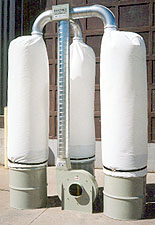
Kraemer Dust Collector
Dust collectors remove the excessive dust that is generated in woodworking or other machining operations and transfer the dust to a storage area for disposal. They create cleaner and healthier air environments in the work place. Dust collection is legally required in work shops larger than a home-based shop. They range in size from small interior units pulling up to 500CFM using motors as small as 5HP to large exterior units pulling up to 100,000CFM using motors as big as 300HP. Interior dust collectors usually collect dust into either 45-gallon drums or plastic collection bags for manual disposal. Exterior dust collectors usually have collection bins built in and will deposit the dust to a container from time to time. Once the containers are full, the collected dust is then hauled away by truck. Some systems are set up so the collected dust is continuously pumped into a sealed container. Dust collectors usually filter the dirty air through cloth bags that act as a filter medium. Many collectors use a cyclone to separate out bigger, heavier particles before reaching the filter bags. The exterior unit's filter bags are periodically cleaned either by a shaker or an air pulse cleaning system to extend their useable life. Because of the large volume of air removed from a plant by an exterior unit, many are equipped with a return system to return the heated factory air after it is cleaned. This also significantly reduces the negative pressure caused by removing large volumes of air.

Popular brands of dust collectors include:  ACT, Aget, Belfab, Concept Air, Delta, Denray, Donaldson Torit, Engineered Air, Kraemer, MacDonald, Murphy, Oneida Air Systems, Spec Air, and Walco.


Check out a broad selection of dust collectors at Contacts Machinery's used woodworking equipment site.  For more information, call 1-866-514-0890.

Santex extends textile finishing niche in Asia

Santex extends textile finishing niche in AsiaWith three months ahead, worldwide exhibitors are preparing actively for their participation at ShanghaiTex 2011 which will be held on June 14-17, 2011. China is viewed as one of the fastest economic growth regions in the world. The market has huge domestic demand for textile and clothes. Exhibitors take advantage of Shanghaitex’s geographical location and its long history in China to expand their market shares, pitch new buyers and maintain customer relationship.

While the Knitting Machinery and Hosiery Machinery zone is always in the spotlight at ShanghaiTex, Printing Machinery, Dyeing Machinery and Finishing Machinery will be another most popular product category this year, with Swiss manufacturer Santex being a key exhibitor on top of Benninger, also from Switzerland.

Santex has planned to extend its production projects in Asia with improved technology know-how in textile finishing. Meanwhile, the company has invested into new coating technology after seeing a growing demand for such system.

ATA Journal visited Santex’s headquarters in Switzerland and spoke to the company’s CEO, Antonio Staffoni. Mr Staffoni said, “We have a two-legged development model. China is located at the heart of Asian market, while in Europe we produce a lot of highly customized machines. Here in Switzerland, we focus on production and design of machines for technical textiles, composites, and textile finishing. We have a plan to improve the production in China for Asia market by strengthening the technology know-how in our factories.”


Maximize your profit, Maximize your gain - Be a Premium Member